
Flights are easy to price. So is a hotel. The part nobody can tell you in advance is everything else: what you’ll spend once you’ve landed. Lunches, tram tickets, the museum everyone says you can’t miss, the airport transfer you forgot to count.
“Is Nice expensive?” is a question I hear all the time. I’ve lived here since 2014 and I work as a guide, and for years my honest answer was “it depends”. It depends on the month. It depends on whether you eat your main meal at lunch or at dinner. It depends on whether anyone told you that the airport tram is free for the first stop. All true, and no help at all to someone trying to plan a budget.
So I built tripcosts.app. It’s a free site that turns “it depends” into numbers: an estimate of what a stay will cost you on the spot, for the French Riviera and a growing list of other places.
How it works
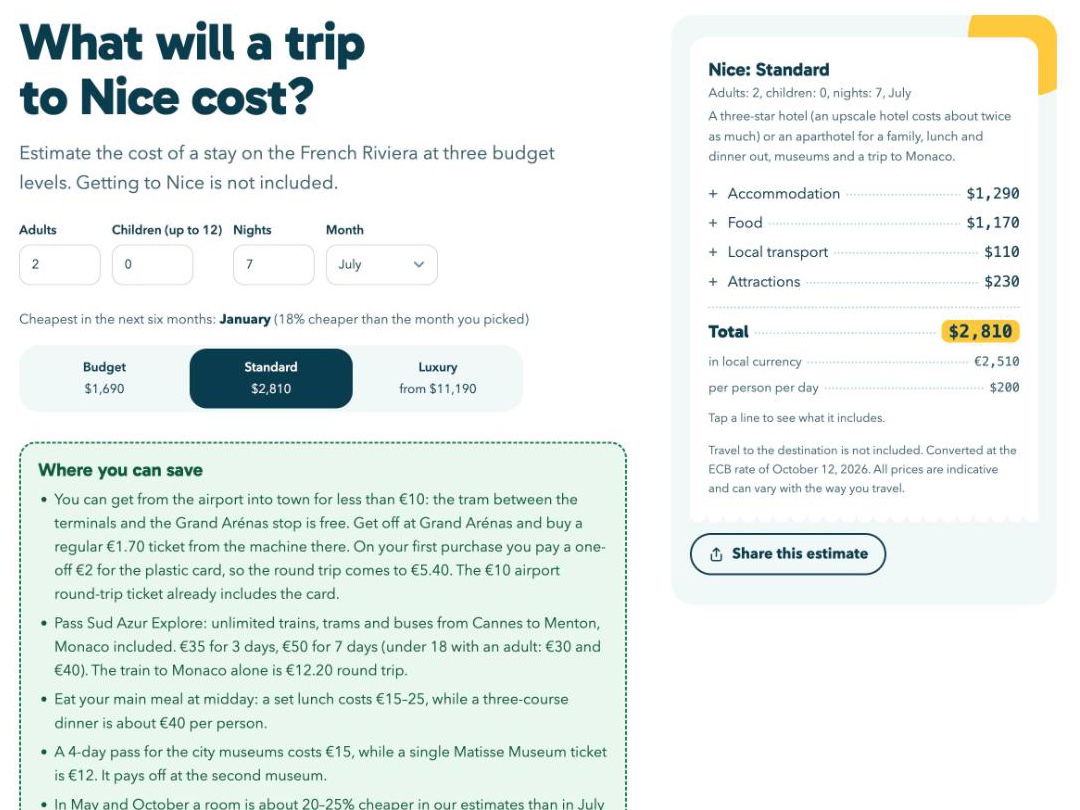
You pick a destination and tell the calculator four things: how many adults, how many children (up to 12), how many nights and which month. Exact dates aren’t needed.
The answer comes as a receipt, in three versions of the same trip:
- Budget: a hostel bed or a simple apartment for a family, bakeries and inexpensive places to eat, public transport, mostly free sights.
- Standard: a three-star hotel or an aparthotel for a family, restaurants, public transport and the main paid attractions.
- Luxury: a five-star hotel, the best restaurants, taxis and private tours. This one is shown as “from”, because it has no upper limit.
The receipt has four lines: accommodation, food, local transport and attractions. Tap a line and it tells you what’s behind the number. “Local transport” in Nice, for example, is a 7-day pass for the trains, trams and buses along the whole coast. Under the total you get the same amount in euros and the cost per person per day.
Getting to the destination isn’t included. Flight prices depend too much on where you start and when you book.
The same week, three very different prices
Here’s what the calculator shows for two adults spending seven nights in Nice, at the exchange rate on the day I’m writing this:
| January | July | |
|---|---|---|
| Budget | $1,050 | $1,690 |
| Standard | $2,300 | $2,810 |
| Luxury | from $8,180 | from $11,190 |
A family of two adults and two children pays about $3,860 for a Standard week in July. Children count as 60% of an adult for food and 50% for attractions, and a family gets one apartment instead of two hotel rooms.
The month matters more than most people expect, and it matters more the further west you go along the coast. A typical three-star double room costs about $110 a night in Nice in January and $180 in July. In Cannes it’s $110 in January and $280 in June, when the big conventions are in town. In Saint-Tropez it’s $120 in November and $530 in July and August. The Saint-Tropez figures are my own estimates, and many hotels there close for the winter, so treat the off-season price with care.
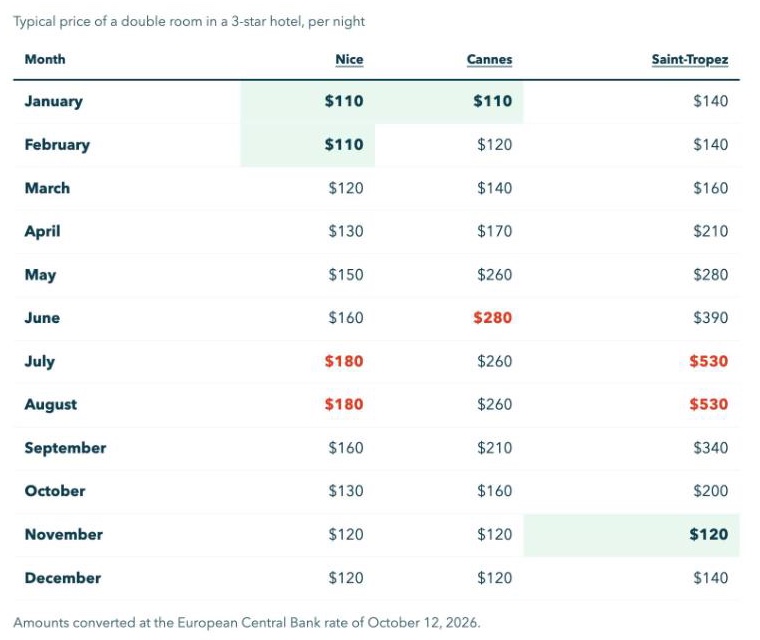
The typical price of a three-star double room per night in Nice, Cannes and Saint-Tropez. Green is the cheapest month in each town, red the most expensive.
Under the form there’s a one-line hint that does this comparison for you. Pick July in Nice and it says: “Cheapest in the next six months: January (18% cheaper than the month you picked).”
It warns you about the expensive weeks
A monthly average hides the worst days. A room in Cannes in May is one thing. A room in Cannes during the film festival is something else.
So when you pick a month with a big event in it, the calculator tells you: the name, the dates, one sentence about what it is, and a note that accommodation prices usually rise sharply in that period. Cannes has five of them, from the property fair in March to the television market in October. Nice has Carnival in February and the Monaco Grand Prix in early June, when race fans sleep all along the coast.
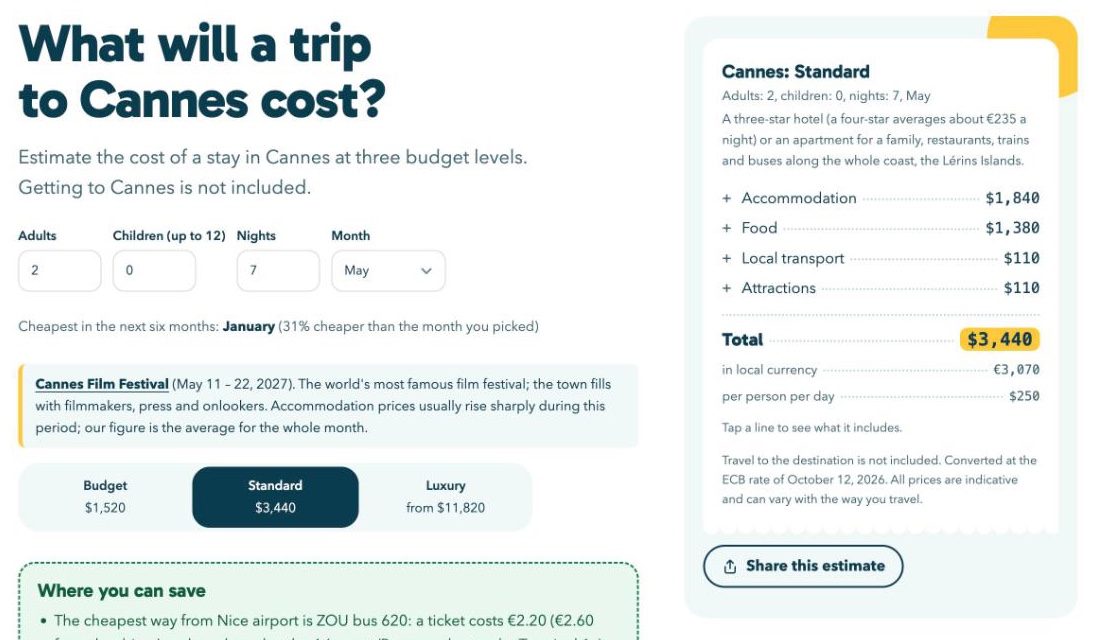
Cannes in May: the calculator points out the film festival and its dates. The estimate stays the average for the whole month.
The estimate itself doesn’t change. It stays the average for the month, and the note tells you which days to avoid if you can.
More than a total
The number at the bottom of the receipt is useful, but the lists under it are what I’d actually use when planning. For every destination and every level you get:
- Where to stay: named hotels and hostels with their address, five of them at the Standard level, each checked for its star rating before it went on the site.
- What to do: the main attractions with their current ticket prices, and the free ones.
- What food costs: a set lunch, a three-course dinner for two, a cappuccino, and a short list of supermarket prices.
- Getting around: single tickets and passes, and how to get in from the airport the cheap way, the comfortable way and by taxi.
- Where you can save: specific tips, not general advice.
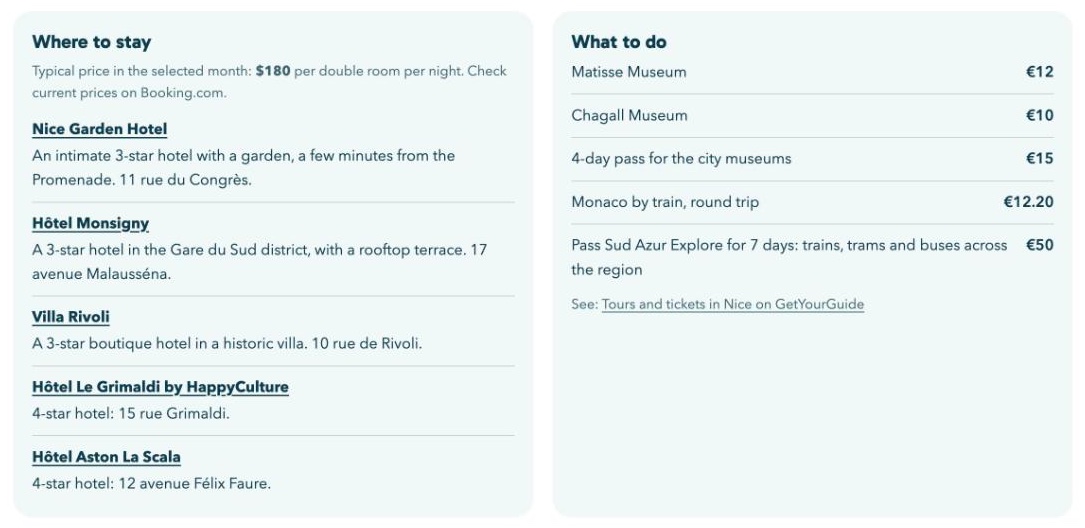
Part of the Nice page at the Standard level: five hotels with addresses, and what the main sights cost.
That last list is where living here helps. Two examples. The airport tram ticket in Nice costs €10 for a round trip, but the tram between the terminals and the Grand Arénas stop is free. Get off there, buy a regular €1.70 ticket from the machine, pay a one-off €2 for the card, and your round trip costs €5.40. And if you’re staying in Cannes, the express bus from Nice airport costs €21.40 and the train €9.70, while the regular bus 620 does the same trip for €2.20. It takes much longer, but on a tight budget that’s two lunches.
Prices in the lists are in the local currency. One button switches them all to US dollars, which helps a lot in places like Budapest, where a museum ticket costs several thousand forints.
Two road trips, one of them a ferry ride from Nice
Some trips don’t fit the “one city, so many nights” model, so the site now has road trips too. Instead of the number of nights you pick a route, and the car gets its own line on the receipt: the rental, fuel for the whole route and parking, priced per car and not per person.
The first one I’d point Riviera visitors to is Corsica. The ferry leaves from Nice, and I’ve driven all three routes on the site: the whole island in 11 nights, or a week in the west (Calvi, Porto, Ajaccio) or in the east (Bastia, Porto-Vecchio, Bonifacio). For two people at the Standard level, the whole island comes to about $4,680 in June and $5,540 in August. A week in the west in June is about $3,020. The fuel price comes from Corsican gas stations and is refreshed every night.
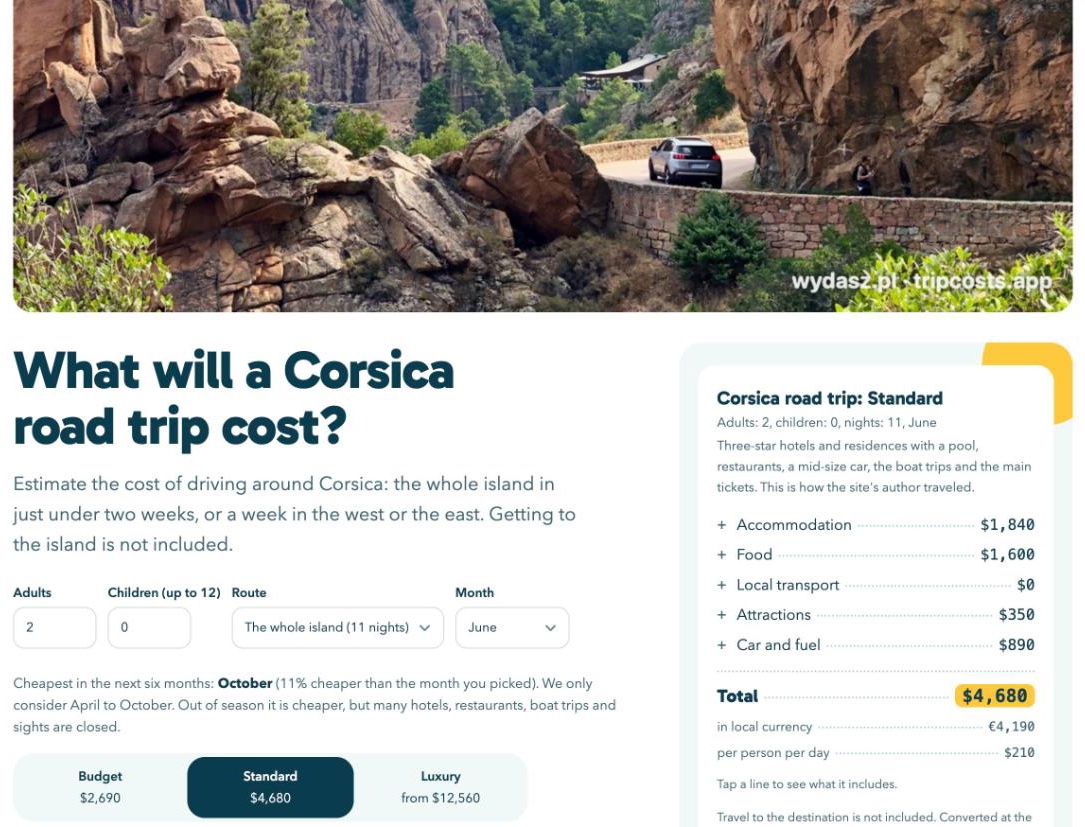
The Corsica page. The photo is the road through the Calanques de Piana, between Porto and Ajaccio.
The second is the US West Coast: a two-week loop from San Francisco or a three-week loop from Los Angeles that adds Route 66, Sedona, Monument Valley and Zion. Two people in June at the Standard level: about $7,000 and $10,580.
Where the numbers come from
Every price has a source, and the sources are listed at the bottom of each page together with the date the prices were collected. Ticket prices come from the official sites of transport operators, museums and tourist offices. Restaurant and supermarket prices come from Numbeo. Hotel price levels and the cheapest and most expensive months come from KAYAK and from official tourism statistics.
Some figures are my own estimates, and the site says so wherever that’s the case. Hostel beds and three-star rooms are the main example, because no source publishes reliable averages for them. The Luxury level is an assumption by nature.
Exchange rates are the European Central Bank’s reference rates, refreshed every night.
So this is an estimate, not a quote. It’s meant to tell you whether your week will cost closer to $2,000 or $4,000, and where the money goes.
17 cities and two road trips so far
- French Riviera: Nice, Cannes and Saint-Tropez
- Provence: Marseille and Avignon
- Elsewhere in France: Paris, Lyon and Bordeaux
- Italy and Portugal: Rome, Milan, Lisbon and Porto
- Central Europe and the UK: Warsaw, Budapest, London and Edinburgh
- United States: New York
- Road trips: Corsica and the US West Coast
The home page also shows three “deals of the month”: the places where accommodation is cheapest right now compared with their own peak season.
Three guides built from the same data
Because all the prices sit in one place, I could turn them into comparisons that update themselves:
- Which city is cheapest for a weekend trip? ranks 16 cities by the cost of three nights for two. Right now Avignon, Warsaw and Porto come in at about $670 to $730, and New York at about $1,670.
- When is the French Riviera cheapest? shows accommodation prices in Nice, Cannes and Saint-Tropez month by month.
- Airport to city center: what does it cost? compares the cheap way, the comfortable way and the taxi in 16 cities.
A few practical things
The site is free and there’s nothing to install or sign up for. It works in a phone browser. It’s available in English at tripcosts.app, with prices in US dollars, and in Polish at wydasz.pl, with prices in złoty.
If you’re planning a trip with someone else, there’s a “Share this estimate” button. It sends a link with your party, your nights, your month and your level, so the other person sees the same receipt.
Some of the hotel and tour links are affiliate links: if you book through them, I may get a small commission at no extra cost to you. The site has no cookies and no advertising trackers.
What’s next
I’m adding destinations as I collect and check their prices. Tuscany is next on the road trip list. If there’s a place you’d like to see, or if you spot a price that’s out of date, let me know. I’d rather fix a number than leave a wrong one online.
👉 Open tripcosts.app

Leave A Comment